Showing posts with label ABMF 4084 Corporate Finance. Show all posts

Wednesday, February 6, 2013

Tutorial 2

Q1. 
Year Project A Project B
0 -200 -200
1 80 100
2 80 100
3 80 100
4 80  
a) If the opportunity cost of capital is 11%, which of these project ts is worth pursuing. Use both IRR/ NPV for calculation.
(Click picture to enlarge)

Answers using  financial calculator: 
IRR - A= 21.86%, B=23.37%
NPV - A= 48.1956, B=44.37147

b) Suppose you could only choose one project, which project would you choose?

- Project A, because of higher NPV

c) Which project would you choose if the opportunity cost of capital is 16%. Use both IRR/ NPV for calculation. 

Answers using financial calculator.
IRR - A=21.86%, B=23.37%
NPV - A=23.85%, B=24.59

-Project B because higher NPV

d) What are the internal rates of return of projects A & B?
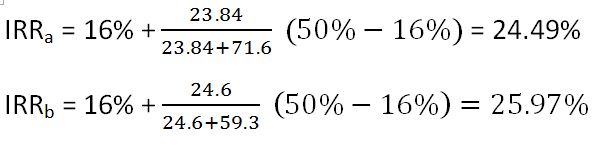

e) Based on your answers above, is there any reason to believe that the project with the higher IRR should be chosen?

 - Project B, because IRR of Project B is more than Project A. Therefore Project B has a much better chance of growth.

f) If the opportunity cost of capital is 11%, what is the profitability index for each project? Does the profitability index ranks the project correctly?

- Profitability index = NPV / Initial investment
PI for Project A = 48.24/ -200 = -0.2412
PI for Project B = 44.4/ -200 = -0.222

- Yes

g) What is the simple payback period of each project?


- Project A - 200/80 = 2.5 years
- Project B - 200/100 = 2 years

Q2. Luxury Home Furniture is considering two independent projects that have initial investment of RM120,000 and RM96,000 respectively. The projects' estimated cash flows are summarized below
a) Luxury Home Furniture's current investment policy is to accept only projects that are recoverable within 3 years. Calculate the discounted payback period if the cost of capital is 10%. Advise the company in which project to invest based on payback period.

(Click picture to enlarge)

Payback for A = 3 + (672/ 24588) = 3.03 years
Payback for B = 2 + (21636/ 27036) = 2.8 years

b) Calculate the NPV for project A and Project B, if the required rate of return of the company is 12%.


c) Calculate the Internal Rate of Return of both projects.


Tutorial 1

1. Discuss why corporations typically exhibit separation of ownership and management, as distinguished from sole proprietorship or partnerships.

- Diverse ownership -> large entity - company is big - has many investors
- Difficulty in co-ordination for decision making
- Appointing a management team -> more efficient decision making and the team has the knowledge in the field
- Business continuity -> even if one of the investor past away

2. Why is limited liability such an important aspect to investors?

- Do not have to bear losses more than what you have invested
- Do not want to be responsible for decisions made by management team and daily operating risks there are involved in
- Prepared to lose only initial investments
- Limited liability will affect availability of funds. Limited liability attract more investors to invest, therefore able to gather more funds.

3. Distinguish between a firm's capital budgeting decision and financing decision.

- Capital budgeting is concerned with investing in assets (tangible/ intangible). Eg, decision to invest in a new company, decision to place a new computer in the company.
- Financing decision is concerned with how to raise finds. Eg, decision to borrow loans, decision to issue share


4. Discuss the interrelationship between a firm's financing and capital structure decisions.

- Capital structure is the composition of funds. Such as bonds, bank loans, share and preference share.
- Financing decision concerns on how to raise funds. Such as issue bonds, bank loan, share and preference share.
- Factors affecting financing decision: 
a. interest rates
b. time preference
c. latest payments composition of funds - before deciding to take back loan, must consider present company's gearing
d. gearing
e. control - if it is equity financing, then no control (investors will control); if it is debt financing, then there s control.
f. size of the fund that you want.

5. Who are the financial managers in large corporations?

- Chief financial officer (CFO)/ Finance director - Responsibilities: financial strategy and policy, corporate planning.
- Treasurer/ Financial manager - Responsibilities: risk management, funding, cash management, banking relationships, mergers and takeovers.
- Controller/ Chief accountant - Responsibilities: financial accounts, management accounts, investment appraisal, taxes

6. Describe agency problems in general, and offer at least three examples from corporations.

-  Owners - maximize company's value, profit, increase share price
- Managers - maintain company and also self interest which is to do their jobs right and avoid failure and risky projects
- Both parties have conflict of interest
- For example: Owners wanted to invest in Project A because the project could bring higher return. But the managers see Project A as a very risky project which chances of failure rate is high. To protect their jobs, the managers refuse to carry on with Project A. -> Agency problem occur.
- Agency problems occur because: 
a. tendency to invest in sale projects
b. tendency to justify high risk projects are not viable (not practical)
c. tendency to reward themselves

7. Tabulate and compare the differences among corporations, proprietorship and partnerships

- Sole proprietorship and partnerships - unlimited liability, personal tax on profits
- Corporations - limited liability, corporate tax on profits + personal tax on dividends